The Four Ways to File a Canadian Year-End — and How to Pick the Right One

Authored by Joel MacGillivray, CPA, Manager of Corporate Reporting
I've sat across from a lot of business owners over the years. Many are unsure about the level of year-end reporting they need, usually because the firm they've been with previously recommended a type of year-end reporting based on fees, rather than by need.
There are four levels of corporate year-end reporting, and the driving factor to choosing the best type for your business is:
Who reads and relies on your financial information?
That's it. The rest comes down to what fits other specific needs of your Company.
This guide walks through the four levels of financial reporting — what each one is, where each level falls on a scale of cost, and how to assess your own needs.
The four levels:
1. GIFI Engagement (General Index of Financial Information):
This is the most basic of the four engagements. A GIFI engagement compiles the general financial information of a corporation for the purpose of completing the corporate tax return. This type of engagement does not involve any form of analytical review or preparation of external financial statements, and is the base requirement of a corporation’s year-end needs.
What’s included: A completed and filed T2 Corporation Income Tax Return.
What’s excluded: External financial statements, any level of assurance.
Who does it fit: Holding corporations, companies with limited activity, owner-managed businesses who operate at a scale where the owner is actively involved in the day-to-day, bookkeeping is kept in-house with internal financial reporting frequently provided to management, and no financing arrangements exist that might require an elevated level of engagement.
Where it falls on the price scale: A GIFI engagement will likely be less costly than any of the other corporate year-end reporting option due to the lack of external financial statements provided and analysis performed.
2. Compilation Engagement (formerly referred to as “Notice to Reader”):
In a compilation engagement, financial information is provided by management, and using this information, the Practitioner provides formatted compiled financial information. No audit or review procedures are performed; however, a basic level of analysis is applied to identify any significant or unusual fluctuations or balances to help ensure the financial information is not misleading to users/readers. The financial information is also reviewed for consistency and mathematical accuracy.
1. What’s included:
A balance sheet, giving a “snapshot” of where the Company stood financially at the end of your most recent fiscal year.
An income statement, showing the profit or loss of the Company. Showing how your company performed this year.
The basis of accounting note to explain the methods used to record financial transactions.
2. What’s excluded: Assurance – no level of assurance is provided over the financial information. Compilations exclude extensive analysis and verification of accounts/transactions typically performed during assurance engagements.
3. Who it tends to fit:
If you have financing with an institution that requires Compiled Financial Information, or if you have investors that require Compiled Financial Information annually, this is the this is the level of year-end financial reporting for you.
If you are a small to medium sized business with investors, owners, or management that require more than the Company’s internally prepared financial statements. Externally prepared compiled financial information provides standardized, well-organized statements that enhance clarity, allowing the readers to assess the Company’s financial position and performance.
4. Where it falls on the price scale: Typically, a compilation engagement will cost more than a GIFI, but less than a review or audit. This is the “middle-of-the-road” level of year-end report and suits the needs of most small businesses.
3. Review Engagement
A Review Engagement is the first step into assurance. Assurance is essentially the comfort a CPA can provide over the accuracy and reliability of financial statements, based on the procedures that the CPA performs on the financial information.
The Review Engagement provides limited assurance over the financial statements. This is because the CPA is focused on performing inquiry with the client and analysis of financial balances and trends, to assess whether the numbers make sense. During a Review Engagement, the CPA is not normally tracing transactions against their source documents, performing balance verifications or sending third party confirmations, which are typically audit procedures.
The Review Engagement is also the point where Canadian accounting standards come into play for the preparation and presentation of the financial statements. As a result, users can expect a significantly enhanced level of financial reporting compared to Compilations. Reviewed financial statements include comparative figures, a statement of cash flows and detailed disclosures of the accounting policies used in their preparation. In addition, note disclosures are provided to support the balances reported in both the balance sheet and the income statement, offering greater transparency of the entity’s financial position and performance.
What’s included: Financial Statements prepared in accordance with the Canadian Accounting Standards, an Independent Practitioner’s Review Engagement Report, financial statement notes and comparative figures. Review of your entity’s operational results, significant changes or unusual items through analytical procedures and inquiry with management.
What’s excluded: Audit procedures, findings and Audit report.
Where it falls on the price scale: A Review Engagement will fall toward the middle/higher end of the scale, typically less costly than an audit but more costly than a GIFI or Compilation due to the additional procedures performed and the application of accounting standards for the financial reporting.
Who it tends to fit:
If you have financing with an institution that requires Reviewed Financial Statements, or if you have investors that require Reviewed Financial statements annually, this is the this is the level of year-end financial reporting for you.
A large-scale operation where decisions are made by a Board of Directors who are not involved in the day-to-day operations may also benefit from a limited-assurance level engagement.
4. Audit Engagement
The audit provides the highest level of assurance available. An audit under Canadian Auditing Standards gives a formal opinion on whether your financial statements present fairly, in all material respects, the financial position and operations of the business.
What’s included: Everything you get in a review, plus more extensive work that comes with an audit. This includes but is not limited to, tracing transactions against source documents, performing balance verifications, assessment and testing of internal control procedures, and the issuance of a formal audit opinion on the financial statements.
Where it falls on the price scale: Typically, an audit will be the most expensive of the four options for corporate year end engagements due to the highest level of assurance and work performed.
Who it tends to fit: An audit is usually the right fit when your business has a high level of external accountability. That often includes companies with institutional investors, organizations receiving government funding above certain thresholds, businesses in regulated industries, many not-for-profits, and companies whose financing or shareholder agreements specifically require audited financial statements. It is also common for government-funded organizations and some franchisors to require an audit as part of their reporting obligations.
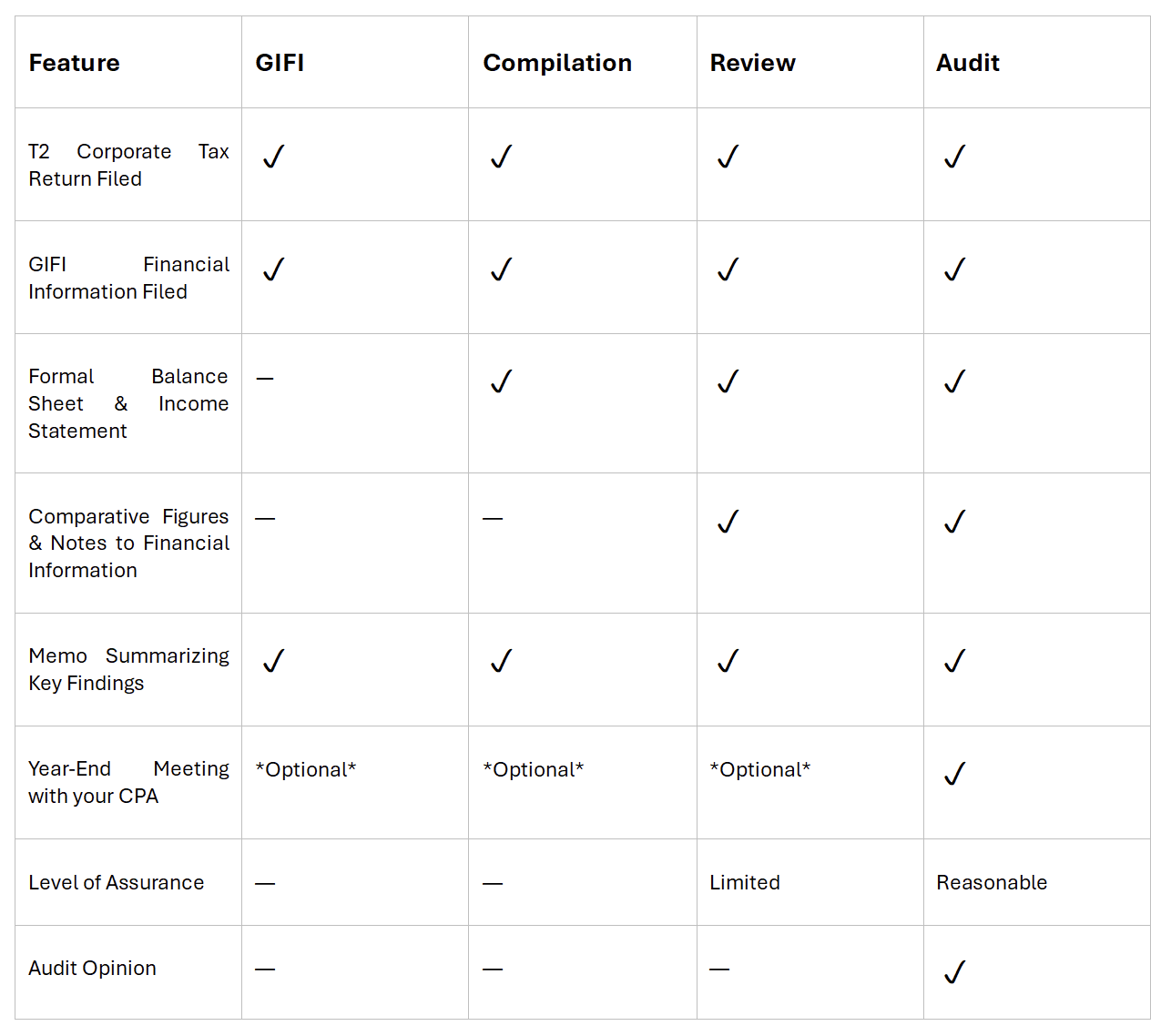
Review and Audit figures are indicative industry ranges for Canadian SMBs — FHB doesn't take on new engagements at these tiers (see the scope note above).
How to match your needs
I built a brief survey of six questions which will show you what type of year-end reporting is likely your best fit. It's not a substitute for a conversation, but it's a useful starting point.
If you'd rather talk it through, you can book a 15-minute call with me directly. No sales pitch. Just a straight read on which tier fits your specific situation.
What FHB Offers
At FHB, we provide both GIFI and Compilation engagements to new and existing clients.
We understand however, that every client’s needs are unique. While Compilation or GIFI engagements typically involve limited procedures, we offer the flexibility to enhance our level of review when additional scrutiny over a company’s books is requested. For instance, when a new bookkeeper joins your company, you may want extra confidence in the accuracy of your financial records—without the cost or complexity of a full Review Engagement. In this type of situation, FHB can provide a more in-depth review of your accounting data file before completing your Compilation, giving you greater peace of mind.
Although we do not take on new Review or Audit engagements, our experienced team is eager and committed to support these business in other meaningful ways. We offer practical, value-driven services such as tax planning, management consulting, review and recommendations on process improvements, audit preparation assistance and reliable bookkeeping support.
Please contact me if you are interested in learning more about what we offer at FHB.
→ Get in touch with F.H. Black & Company
Joel MacGillivray is a CPA and Manager of F.H. Black & Company CPA Inc.ʼs Corporate Reporting Division in Winnipeg. He works with owner-managed businesses on year-end engagements, financial reporting, process improvements and controllership support.